Top > Features > Animations > Evidence > About | Log in

Challenges teachers and students face?
Concerned teacher

Teachers

💭

Students forget
right away?

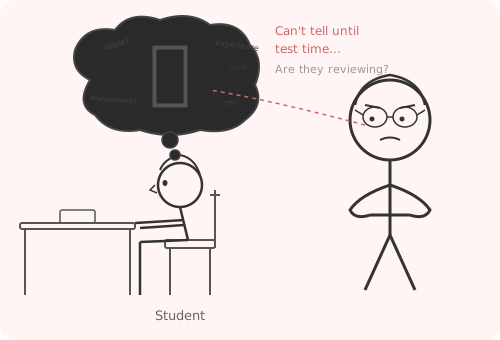
Hard to see
class retention status?

📝

Review instructions
become meaningless?
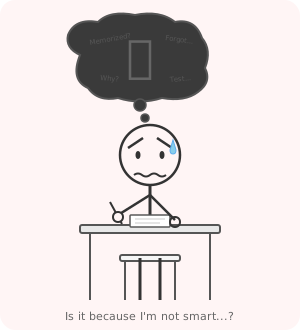
Concerned student

Students

📝

Memorized before the test...

Can't recall during exam?

💡

Understood in class...

Forget it quickly?

📚

Studying hard...

Grades won't improve?

Ever experienced this?
Concerned person

I thought I remembered...

Can't recall it?

I studied...

Forget it quickly?

I'm trying hard...

Doesn't seem to stick?
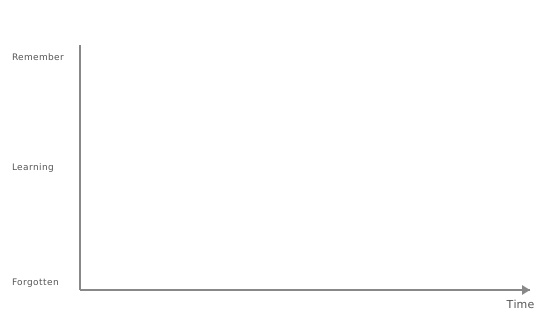
Is it because I'm not smart...?

No, that's not it. The cause lies in 'how the brain works'

Top > Features > Animations > Evidence > About

Why do we forget?

Why forget?
Because we don't review
Why don't we review?
Because we think 'I understood it once, so I'm fine'
However...
The brain distinguishes between 'understanding' and 'memory retention'

How memory works according to neuroscience

  • Understanding alone does not yet mean the knowledge has been retained.
  • Information that is not revisited tends to become harder to retrieve over time.
  • When the same information is input repeatedly, the brain judges it 'important'
  • Synapses (neural connections) are strengthened and become 'long-term memory'

...therefore

Review is essential.

※Based on Ebbinghaus's forgetting curve and synaptic plasticity research

Why do we think we're 'fine' without reviewing?
▼ Learn more

Feeling like you've 'already memorized it' right after studying is a brain illusion proven in cognitive psychology.

In other words, the feeling of being 'fine' is the biggest reason people don't review. Recognizing this illusion is the first step to effective learning.

Why does the brain judge unrepeated information as 'unnecessary'?
▼ Learn more

The reasons why the brain actively erases memories have been revealed by recent neuroscience research.

  • 1. Prevention of Cognitive Overload:The hippocampus selectively erases unnecessary information to improve the storage and retrieval of relevant memories. This prevents cognitive overload. Davis RL (2017) The Biology of Forgetting
  • 2. Behavioral Flexibility:Being bound by old information prevents adaptation to new situations. Forgetting enables 'relearning' and enhances adaptability to environmental changes. Anderson MC (2021) Active Forgetting
  • 3. Goal Achievement Efficiency:Processes controlling goal-oriented behavior actively forget memories that interfere with behavioral goals. This is a mechanism for maintaining concentration. Bekinschtein P (2018) Nature Communications
  • 4. Emotional Regulation:Remembering unpleasant memories vividly for a long time is mentally distressing. Forgetting is also a function that protects mental health. Nørby S (2015) On the Adaptive Value of Memory Loss

In other words, forgetting is not a 'flaw' in the brain — it's by design. That's why reviewing is essential to signal to the brain: 'This information is important.'

Press the play button below to start

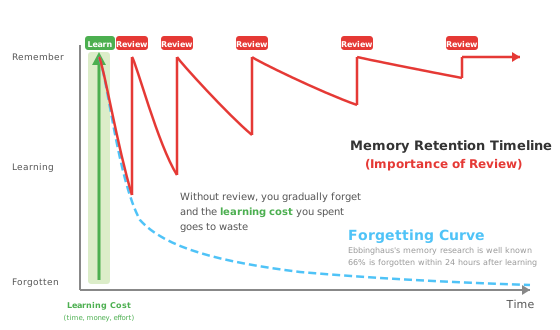
Review helps memory retention

Memory retention animation
Press the play button below to start

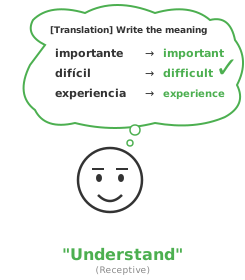
Can 'understand' but
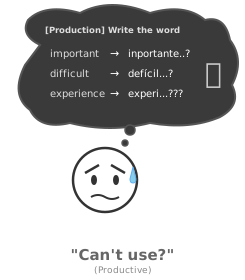
can't 'use'?

'Understanding' and 'Using' are different

※ Especially in language learning

Receptive vocabulary (understand)
However
Productive vocabulary (can't use)

💡 In simple terms...

Memory has levels.

Even if you think you've 'memorized' it, whether you stopped at ❸ or reached ❺ makes a huge difference in test and practical results.

Even if you get the 'correct' answer on multiple choice, it's meaningless if you can't actually use it.

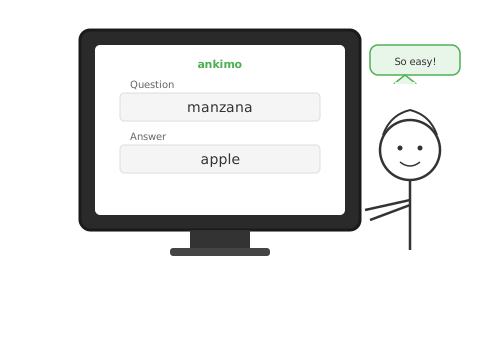
Ankimo uses a 'see the question, recall the answer yourself' format.
We support vocabulary acquisition at a 'usable' level.

Press the play button below to start

⬇️

Ankimo solves all these problems!

Before (Before Ankimo)

Before Ankimo: Forgetting

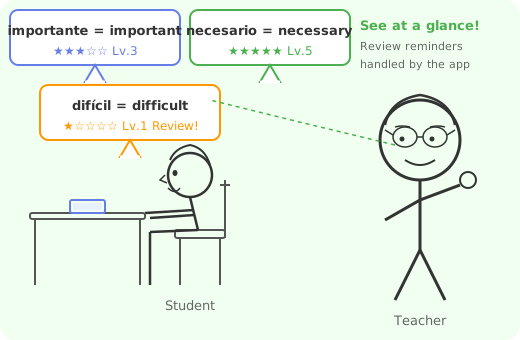
Can't see learning status
Reviews become meaningless

After (After Ankimo)

After Ankimo: Memory retention

Visualize learning status
App supports personalized review

Before (Without Ankimo)

Without Ankimo: Forgetting

Thought I remembered,
but forgot before I knew it?

After (After Ankimo)

After Ankimo: Memory retention

From today, reviews start flowing...
Review habits form naturally

Notifications at optimal timing based on forgetting curve

Auto-reminders based on evidence from spaced repetition research. Prompts review before students forget.

A study comparing 10 learning methods found only 'distributed practice' and 'practice testing' rated high utility
Dunlosky et al. (2013) Psychological Science in the Public Interest
💬

Reach 'usable' level

Students acquire vocabulary through recall format. This supports movement toward productive vocabulary.

Research: Studies show that retrieval-based practice leads to significantly less forgetting over time than re-reading alone (Roediger & Karpicke, 2006)
Roediger & Karpicke (2006) Psychological Science
📊

Visualize each student's memory status

See who knows what at what level in the dashboard at a glance.

Review notifications before forgetting

Send review reminders based on the forgetting curve. Supports long-term memory retention.

A study comparing 10 learning methods found only 'distributed practice' and 'practice testing' rated high utility
Dunlosky et al. (2013) Psychological Science in the Public Interest

Reach 'usable' level

Acquire VKS 4-5 (productive vocabulary) level through recall format. This supports movement toward productive vocabulary.

Research: Studies show that retrieval-based practice leads to significantly less forgetting over time than re-reading alone (Roediger & Karpicke, 2006)
Roediger & Karpicke (2006) Psychological Science

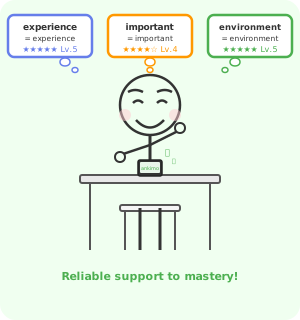
Visualize your memory status

See at a glance what you remember and what you're forgetting. Review efficiently.

This is how memory retention works

Simple input

Starting with simple things...

Advanced input

To slightly difficult content...

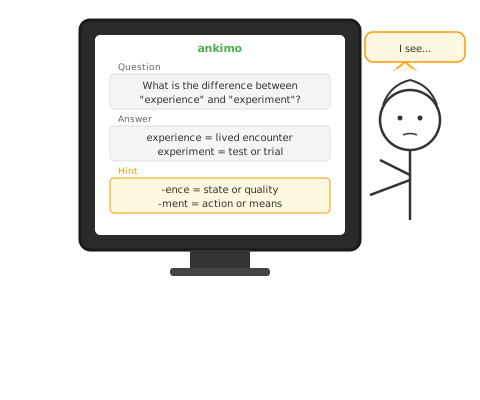
Creating hints is a key to answer recall

Register button

Click [Register] button!

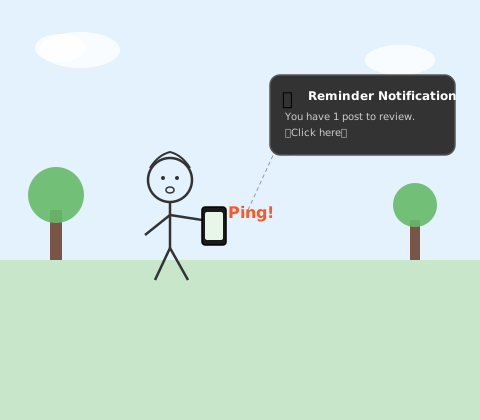
Push notification

Reminder notification for review

※Please allow notifications in your phone's browser

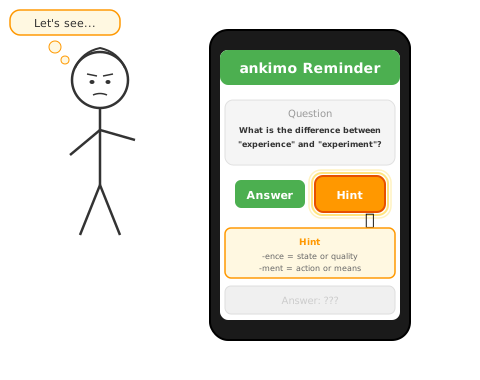
Reminder screen

See the question, recall the answer

Look at hints if you don't know

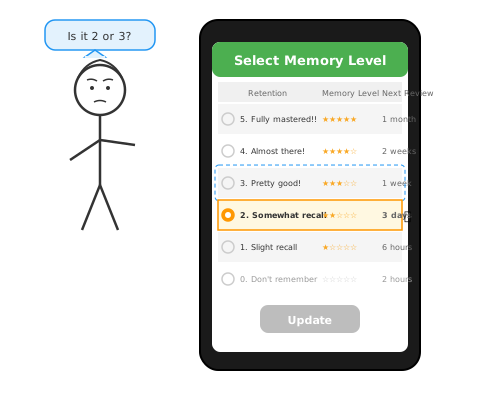
Memory level selection

Choose when you think you'll remember

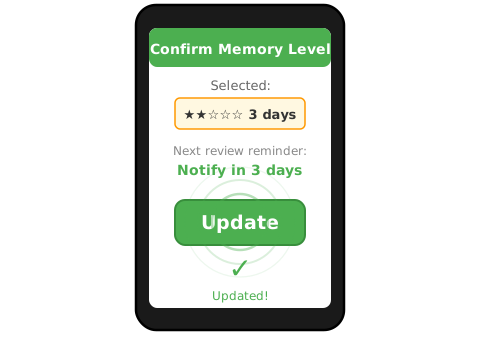
Update button

Click [Update] button!

Next notification arrives at your chosen timing

Memory retention

Memory retention through repetition!

1 / 8